What does "Solander" actually stand for?
The sun is the source of all renewable energy. Our mission is to share it and make it accessible to everyone.
Solander is a neologism combining the Spanish word "sol" for sun with "ander", the last two syllables of "miteinander".
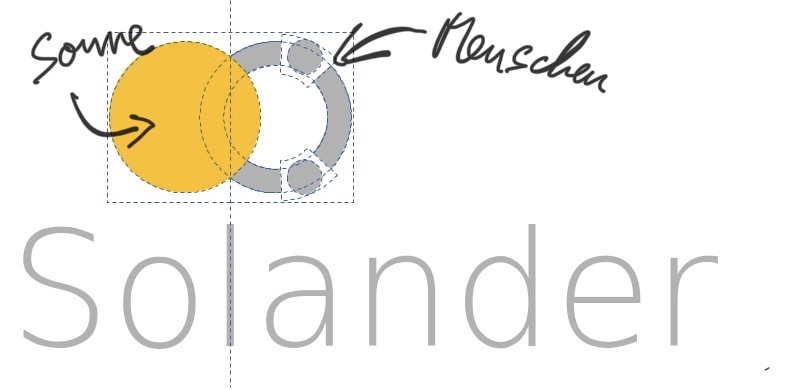
That perfectly captures the essence of our mission: sharing the sun together. In our logo, this is expressed through the orange circle representing the sun and a simplified top-down view of two people holding arms.
Just sunshine together!
These are the goals we are working towards.
Electricity alone is not enough. Only when we decarbonize all energy services will we have achieved our goal of implementing the energy transition. Conversely, this means that we must consider electricity, heat, cooling, mobility, and material flows holistically and integrate them into the design and optimization of the energy system from the outset. Our many years of experience in the design and operation of cross-sectoral, storage-based energy systems help us in this endeavor.
The energy transition is a mammoth project that can only succeed if we all participate. Renewable energies, combined with energy storage, have the potential to make precisely that possible. They are not only emission-free, but often also modular and decentralized, making them, in principle, accessible and usable for everyone. We want to fully leverage this characteristic. Especially in contexts where access to renewable energies is hampered by legal or technical hurdles, we enable barrier-free access.
We believe that wherever renewable energy systems are integrated, the economic benefits must also be tangible. This applies to the operation of energy systems, where we ensure that locally provided flexibility translates into locally measurable financial benefits for the operators. This also applies to the manufacturing of the components we use. Therefore, we strive to use energy technology components from German and European manufacturers whenever possible, thereby achieving local value creation with short supply chains and comparatively low emissions during production.
These are the levers we use to achieve our goals
The currently available grid connection capacity in the distribution network (low and medium voltage) is 10 to 15 times greater than in the transmission network (high and extra-high voltage). This has been the case for some time and is therefore unrelated to ongoing grid expansion. While connection capacities for large-scale storage systems in the megawatt range are currently extremely scarce, we still have enormous grid connection capacities in the distribution network, some of which are barely used and lying dormant. We are identifying these capacities, developing suitable business and operating models and platforms for energy storage systems, and thus contributing to harnessing this potential for the success of the energy transition.
One example of this is our initiative, together with the BKD eV (Association of German Allotment Gardeners), to make Germany's allotment gardens more energy-efficient. 851 of the 13,000 allotment gardens have a distribution grid connection, which is currently used almost exclusively unidirectionally. We want to change this together and transform allotment gardens into active participants in the energy transition. This is particularly effective in winter, when there is virtually no electricity demand in the allotment gardens and the full grid connection capacity is available to provide flexibility.
The historical development of storage capacity expansion progresses from short-term to long-term. This somewhat cryptic statement simply means that, so far, storage capacities with short response times and discharge durations, mostly in the form of battery storage, have been the primary focus of expansion. This is simply because short-term storage has thus far offered the greatest economic viability – primarily through primary control reserve provision, maximizing self-consumption of PV power, and peak shaving. However, for the energy transition to be fully successful, we also need long-term flexibility, for example, through energy storage systems with discharge durations ranging from several hours to days and weeks. The charging and discharging strategies, as well as the cost structure, of such storage systems differ fundamentally from those of short-term storage. We are working to gradually integrate more and more medium- and long-term storage systems into the energy system and are developing the optimal operational management strategies for this purpose. A good example of this is the FlexEhome energy system, which optimizes the parallel use of short- and long-term storage, thus enabling self-sufficiency in PV energy, including heat supply, for a residential building of 97%, while also supporting the grid and energy system. You can find more detailed information here. here.
Solander's work is scientifically sound and methodologically state-of-the-art. We collaborate with research institutes and universities in our projects. We complete the cycle by contributing our expertise in energy storage through university courses. This ensures continuous scientific exchange and allows us to actively participate in translating the latest energy technology findings and methods into practical applications. Here Here are some examples.